Publication
Sociologija i Prostor / Sociology and Space
Author
Jana Čulek
Editors
Lana Petrenel, Ida Križaj Leko (issue co-editor)
Date
9.10.2025.
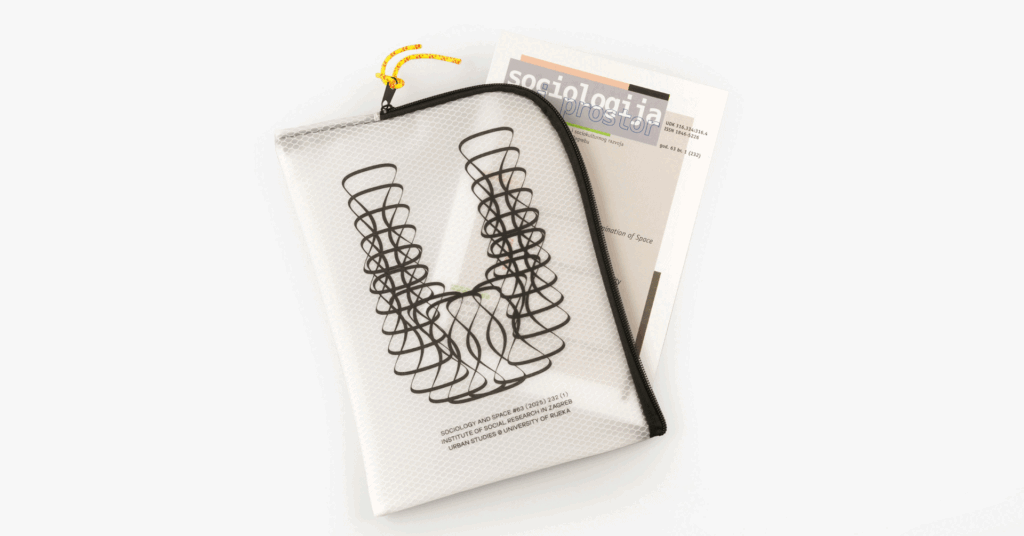
The special issue of Sociologija i prostor, developed in collaboration with the DeltaLab and the Urban Studies programme of the University of Rijeka, brought together interdisciplinary reflections on contemporary urban conditions, speculative futures, and spatial practices, positioning urban studies as a field that productively intersects research, design, and critical imagination. Within this context, Jana Čulek’s paper “Utopia as a Method for the Critical Examination of Space” presented some of the initial conceptual and pedagogical experiments that would later develop into the Edutopia project, exploring how utopia can operate not as a fixed ideal, but as a critical method for imagining alternative socio-spatial futures through education, speculative thinking, and spatial practice.
Paper Abstract
For centuries, utopias have proved themselves an effective and critical tool for addressing our socio-spatial context through offering innovative and creative ideas. Often triggering a holistic and integrated reflection and discussion about numerous aspects of our lives and environments, they allowed us to address a multitude of conditions we face on both the local and global scale. To truly employ utopia as a critical method in the contemporary context we must, however, acknowledge that the time of totalizing utopian narratives is behind us. Within the last century, utopia as a form has undergone significant changes, transitioning from a totalizing image of a complete and perfected world to an entire range of micro-utopias, each equipped with addressing a specific aspect of our socio-spatial environments. Reflecting on some of the critical, speculative, and narrative methods identified in utopias of the 20th century, the paper explores the potential of employing utopia as a critical method for thinking about the space around us, and acting in it holistically and systemically. The paper situates utopia as a method not only within the context of contemporary architectural and urban practice, but – more importantly – in the context of spatial education, where it can encourage long-term spatial change. Addressing several contemporary examples of the use of utopia as a critical method and tool in spatial education, and through presenting two innovative approaches from my own educational practice, the paper identifies the importance of utopia as a method of creative and critical thinking in today’s context of ongoing crises.